Showing posts with label meat. Show all posts

10.19.2008

The Birds

My oven broke down last week, the bottom element had burnt out and sent sparks flying. We had just replaced the element so I decided this would be a good weekend to put it to the test by roasting a chicken. Roasting a chicken isn't a simple task, a good roasted chicken takes skill. I'm almost certain that there are too many people eating overcooked and dried out chicken. A good roast chicken is moist, tender, flavourful and has a wonderful crisp skin. It's not hard to achieve it simply takes patience and attentiveness.

I purchased a grain fed and raised without antibiotics chicken. It was a plump bird weighing in at just over 3 pounds. The process for my roast chicken is to brine, truss, season and roast. Simple, but still a time consuming process that requires planning and the proper preparation.

My step-mother owns a canary who's cage is in the kitchen. As I was preparing the chicken we had a bit of a dialogue:

*Loud chirping*
"What? This? (motioning to the chicken) This isn't my fault, don't look at me!"

*Chirping changes to loud singing
*
"You're a loud little bugger."

*Singing continues*

"I'm not afraid to cook you."

*Silence*

It was a humorous moment that I shared with the canary.

So how did the chicken turn out?


My oven is working just fine, again. Here's to good food and good company, even if my company was only a canar

Read more...

4.03.2008

I love the smell of rot in the morning...

It smells like, victory....


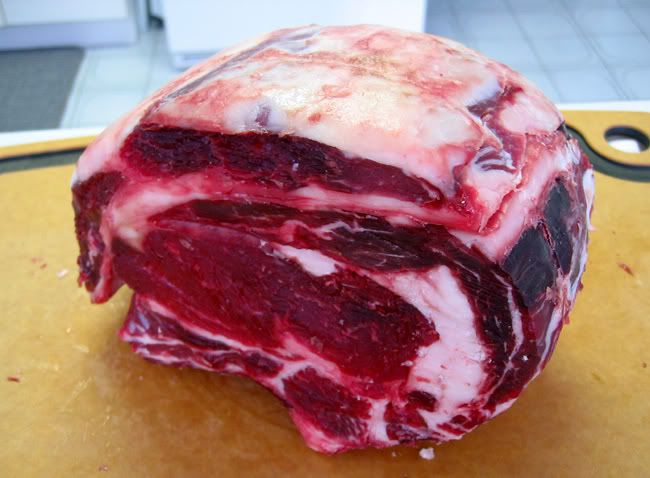
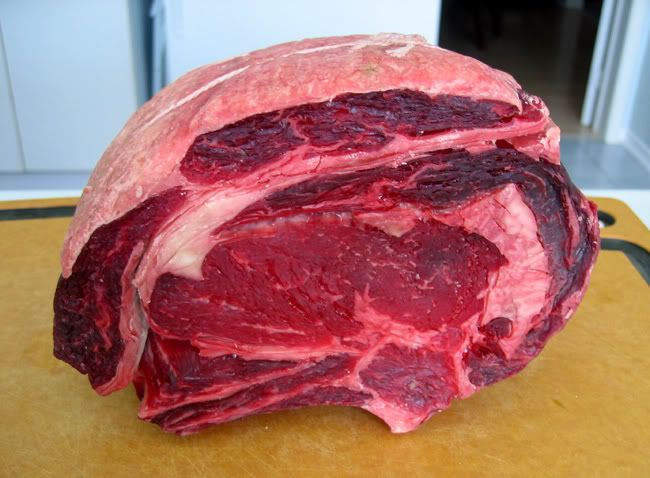
Dry aging meat is something that top restaurants around the world will do. Usually this process must occur in very controlled conditions of temperature and humidity as to ensure proper aging. After all, the meat is just being allowed to rot. I love food, I'm also daring with what I eat and how I experiment. In short, I dry aged a standing rib roast in my home refrigerator.

Dry aging is a timely process. As the meat is allowed to age it dries out and loses moisture, this concentrates the beef flavour. A downside to this is that the loss in weight (from the lost water) increases the cost of the meat. Also, enzymes within the meat break downs the muscle tissues and results in a tenderer piece of meat.

I love roast beef, specifically, I love standing rib roasts. I refuse to call a standing rib roast, "prime rib" unless the beef has come cut from USDA certified Prime beef. If I called every rib roast as prime rib then I may as well call canned tuna "sushi grade tuna". They're two completely different things. Great beef is something special and something to be appreciated. Cooking a rib roast can be simple but for great results you need to begin with great beef, this is what the experiment was about.

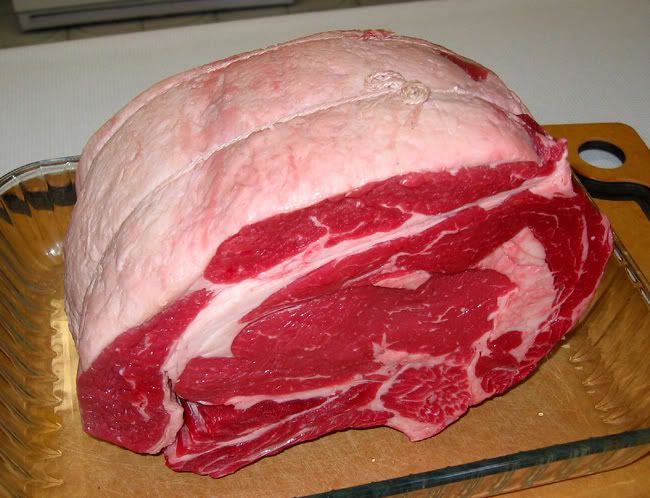
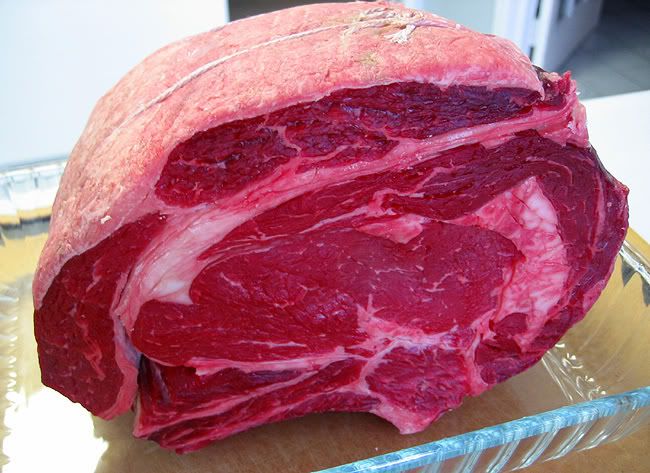
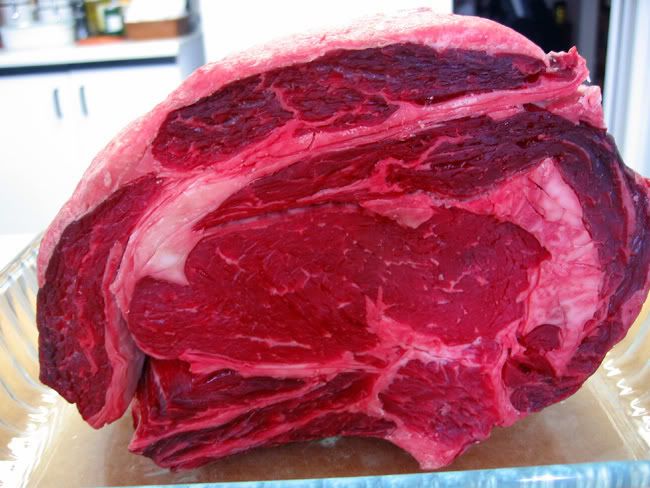
I purchased a Canadian AA grade rib roast that weighed about 3 kg. I aged it in my fridge for 6 days and took photos every 48 hours to document that aging process and how it transformed the cut of meat. At the end of the process I trimmed the meat of leathery and dark portions as well as trimming a thin layer of dried out fat from the cap.

0 hours

48 hours

4 days

6 days

Trim

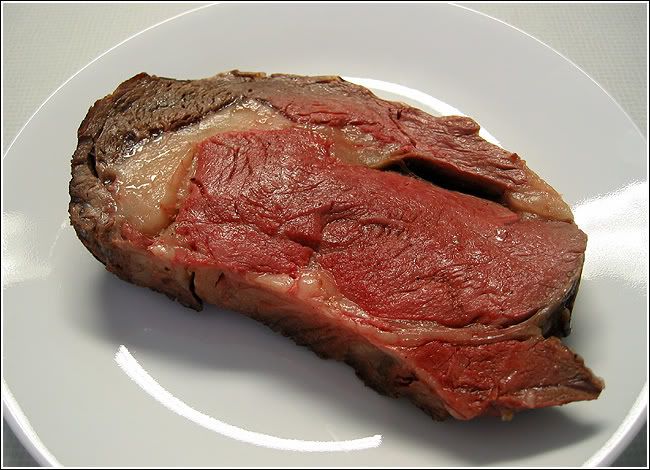
I seasoned the roast with kosher salt and fresh cracked black pepper. I begin the roasting process at a high temperature to sear the meat and then lower the temperature to continue roast. The exact process is 450F for 15 minutes and then lowered to 300F and continue roasting for 15 minutes per pound. I actually learned this technique from the Chef at Home cooking show, this method has never failed me.

Cooking the roast was tricky due to the fact that it had lost water weight from drying out. I estimated that it lost at least 1.5 lbs and cooked it as if it were 5 lbs. Towards the last half hour of roasting I probed the meat using an instant read thermometer to ensure proper degree of doneness.

THE RESULT
Appearance: Medium-Rare beef. Red meat through the cut that dulls in colour towards the edges indicated a higher degree of doneness.

Aroma: Strong beef aroma. Most noticeable upon the first slice in the beef. Fat portions also had stronger beef aroma that expected.

Flavour: Stronger beef flavour in the portions closer to the exterior cut of the meat.

Texture: Tender meat. Most tender portions were those closer to the exterior of the meat. Well done portions were surprisingly tender, having a consistency typical of braised meats.

This experiment was worth it. Next time I want to do it for twice as long and with a better cut of beef. I'll up the ante from AA grade to AAA.

Read more...

2.18.2008

lend me your ears.

I've recently become a strong believer of responsible eating and knowing where the food we eat comes from. I've said it for a while now but I believe a high majority of people are disconnected from their meat. They only see meat as coming in neatly plastic wrapped packages; they miss the part where that cut of meat came from a once living and breathing animal.

People often have trouble consuming cuts of meats when they realize they've come from something alive. The minute you start to eat something like liver, hearts, ears, or tongue you become to connected to that food and that animal. You realize that it was alive because you're aware that your body has those organs or features too.

This weekend I was out grocery shopping at a local Chinese supermarket. In their meat section they have some cuts that one would rarely, or never, find in the average grocery store. As I took my time browsing around I came across pig's ears. I was pretty fascinated with them and decided that this long weekend may be a good opportunity to try my hand at making them for the first time.

I started with this:

And ended up with this:

The entire process of cooking was pretty tedious. Two hours of slow poaching followed by a night of chilling, followed by slicing, and then finally a marinade. The pig's ears are served chilled and deliver a wonderful crunch from the cartilage and a satisfying chew from the skin and fat. The ears themselves don't have much flavor but deliver an wholly enjoyable mouthfeel.

All the flavors are very Asian in origin and distant from what I normally used doing. However, I'm learning and I'm treating this as part of Garde Manger. I've only just started to branch into that area of cooking and I now finding myself wanting to learn more.

I posted my adventure of cooking Pig's Ears on a cooking related community at LiveJournal. I received many favorable comments to what I had done. These are just some of the 150+ comments to what I had done.

"I love your entries because it's so clear that you really, really love food."

"If I didn't know what they were, I'd try them in a heartbeat, they look so good. If I did know what they were, I'd still try them because they look so good, though it might take me a minute longer."

"I totally expected this to be something gross and disgusting and I'm surprised that I'm interesting in trying this. You obviously did a good job in tempting me!"

It's comments like these that make me feel good about what I'm doing and where I'm going with food. I'm pushing myself, going in new directions, exploring new horizons, and learning new things. I'm growing as a cook and that's the most important thing for me. Also, by inspiring others and opening people's minds I feel as if I'm contributing to my craft, which is also important as I am connected to something larger than just what I am doing alone.

Read more...

11.21.2007

braaaaaaaaaaaaaaaaaaaains!

Whenever I'm talking to people about weird and unorthodox foods the topic of brains always comes up. Specifically, live monkey brains. I'm sick of hearing about this so called delicacy that's eaten in parts of East Asia. The consumption of brains as food is not uncommon. However, the belief of eating the brains from a live monkey is down right absurd.

The myth of live monkey brains was likely made popular by the film Faces of Death which staged the eating of live monkey brains. However, there also have been written accounts by people who have eaten or witnessed the eating of live monkey brains. I'm skeptical of these accounts as people can tend to embellish, alter or even fabricate events. A very good example of this is the 2003 memoir A Million Little Pieces written by James Frey.

Another, more familiar, example of monkey brain being served as food (although not live) is in the film Indiana Jones and the Temple of Doom. Chilled monkey brains are served as dessert to Indy and his companions by their Indian hosts. Two very important things should be noted:
  1. Hindus are Lacto-Vegetarians.
  2. The monkey is a sacred animal to Hindus.
Never the less, this film was banned in India for its negative portrayal of Indian people and their culture.

I can admit that there may be a possibility of eating cooked monkey brains. Cooked brains is not unusual as it is part of the fifth quarter of meat (offal). Recently, I stumbled upon Chef Chris Cosentino's blog Offal Good. In one entry he details his preparation of calf brains. In another entry he has photos of a market in Turino selling brains right next to testicles and other offal.

Offal is important part of meat and I'm nearly convinced it's responsible consumption of an animal. Brain could very well be good eats when cooked properly. However, the idea of strapping a monkey under a table, opening it's head like a tin can, and then trying to eat its brains all the while the poor monkey kicking and screaming is very unlikely. Just think of the mess...

All myths and urban legends have a deeper theme and underlying meaning. My interpretation of the myth is an underlying fear of the cuisine and practices of Eastern cultures. This myth likely started in the early to mid 1900s when Eastern cultures were being viewed as uncivilized and filled with ancient mysticism and superstition. Anyone from North America or Europe would obviously view Eastern cuisine as strange and unorthodox.

If you want to believe in eating live monkey brains then you may as well believe in the alligators living in New York sewer systems. Heck, I think Bigfoot has more physical and convincing "evidence" than monkey brains do.

Read more...

11.19.2007

red neck advice.

Last night I was watching King of the Hill on television, it's one of my favourite series. Last night's episode was about organic food and Hank's quest to eat organic after buying tasteless meats and produce from his local supermarket. In the beginning of the episode Hank is grilling steaks for his friends and family. He offers this bit of advice to his son, Bobby Hill.

Hank Hill: Firm but with a little give. Yepp, these are medium rare.
Bobby Hill: What if somebody wants their's well done?
Hank Hill: We ask them politely yet firmly to leave. With great meat, son, comes great responsibility.

I've watched this show a long time and have heard plenty of good lines and bits of "advice". This is probably the best advice I've ever heard.

Read more...

10.31.2007

I'd like that well-med-rare-done

The wedding reception was at a small inn, the food there was surprisingly good. For dinner there was an appetizer, entreé, and dessert. The appetizer consisted of a selection between a soup (leek and potato with stilton) or a basic salad with vinaigrette. For the entreé we had a selection of either Chicken, Beef, or Fish. Being a red meat lover I opted for the Beef.
Grilled Tenderloin of Beef
Topped with Wild Mushroom in a merlot sauce
Mashed Potatoes and Green Beans

Mushrooms, Mashed Potatoes, and Green Beans are hard to screw up. The only complaint I do have about the three of these sides is that the roasted Green Beans were not tender, they were well undercooked. I like vegetables cooked to be fork tender or al dente, whoever cooked the beans should have tasted and checked for doneness before plating.

I'm always wary whenever I order red meat, I like my red meat medium rare and I seldom receive it this way. Harold McGee's book, On Food and Cooking, defines medium rare as:
  • Meat temperature: 130°F/60°F
  • Doneness: Medium Rare, 135-145°F
  • Meat Qualities: Resilient to touch, less slick, more fibrous, releases juice when cut, opaque, ligther red.
The problem that arises is that the USDA defines meat doneness by the following scheme:
  • "Rare": 135-145°F
  • "Medium Rare": 145-155°F
  • "Medium": 155°F
  • "Well": 170°F
For all except well-done the suggested cooking temperatures by the USDA are approximately 10-15° degrees higher than the proper cooking temperature. I suppose this is for the safety of the general public but it's still a giant pet peeve of mine. There's nothing worse than paying $30 for a steak, ordering it medium rare, cutting into it, and then seeing a pink or grey-brown centre.

There's nothing I really have to say about the dessert they served. We had my father's wedding cake served with vanilla ice cream and a raspberry coulis.

I was impressed enough with the food that I spoke to the sales manager, Franklin, about possible employment. Once I finish university in December I want to get into a decent restaurant. I'm looking for a place that will allow me to learn and pick up the basic practical skills necessary to work and survive in a public kitchen. I chatted with Franklin for 5 minutes about my situation and what I wanted to do. He smiled at me, shook my hand firmly, and told me to apply when I'm ready. This place looks hopeful.

Read more...

  © Blogger templates The Professional Template by Ourblogtemplates.com 2008

Back to TOP